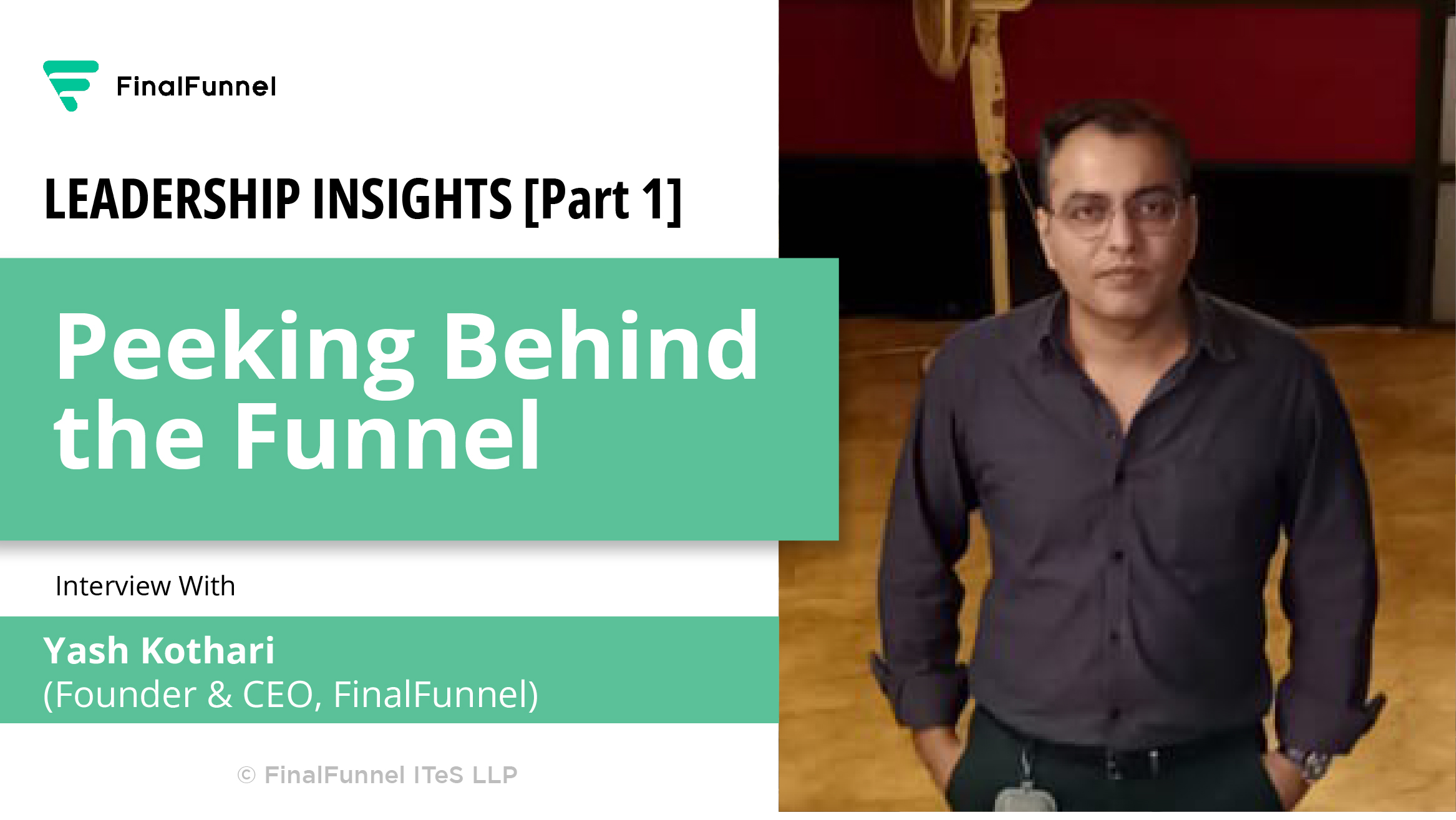
It was an honor to chat with our Founder and CEO to learn all about the story of FinalFunnel and gain more insights into the person behind the entrepreneurial persona.
Q: Please introduce yourself to our audience.
A: I’m a no-nonsense thinker who’s always been wired a little differently – someone who questions the usual and doesn’t shy away from taking risks, even from a young age. Business was never a surprise for me – I always knew I’d thrive in it. I enjoy making bold calls and backing them with action, not noise.
Outside of work, I’m an automobile enthusiast with a genuine love for the mechanics, design, and thrill of great machines. But I also find balance in the calm – I have a deep respect for nature and believe that we should always aim to give more to the universe than we take. That mindset keeps me grounded, intentional, and constantly evolving.
Q: What drew you to the world of marketing – specifically, demand generation?
A: Honestly, I landed in marketing quite accidentally – it wasn’t something I had mapped out early on. But once I got into the demand generation side of things, I was hooked. The mix of creativity and performance really clicked with me.
What I enjoy most is the data-driven nature of demand generation. It’s not just about flashy campaigns – it’s about understanding behavior, optimizing touchpoints, and driving real, measurable results. There's a constant challenge to refine, test, and improve – and that keeps things exciting and meaningful for me.
Q: What was the very first step you took after deciding to launch FinalFunnel? Can you walk us through those early days – the challenges, the triumphs, the "aha!" moments?
A: The very first step after deciding to launch FinalFunnel was getting hands-on with sales and business development. While the fundamentals came naturally thanks to my business background, I’d previously burnt my hands relying on someone else to handle that piece – and I knew I couldn’t afford to make that mistake again.
I dove deep, learning the nuances of demand generation and understanding how the industry actually works – the standards, the expectations, and the lesser-known tricks of the trade.
One of the biggest early challenges was funding. Being a service-oriented business, we needed people – and people meant salaries. Managing quality delivery while staying lean was a tough balance.
Another major hurdle was finding and identifying the right clients. Not every lead is the right fit, especially in B2B, and learning to say no was just as important as chasing the yes.
But the best moments? Seeing the hard work translate into actual profits and client success stories. That’s when it all felt worth it – not just building something from scratch, but knowing it was working, and working well.
Q: Demand generation has evolved significantly since 2016. What have been the biggest shifts you've had to navigate?
A: One of the biggest shifts I’ve navigated since 2016 has been the transition from 100% telemarketing to a much more digital-first approach. Initially, demand generation was heavily call-driven, but as buyer behavior changed and digital channels matured, we had to evolve quickly.
Surprisingly, the shift has been quite pleasant – digital marketing opened up new layers of targeting, tracking, and engagement – though it came with its own set of challenges in terms of tools, talent, and keeping up with platform changes.
Another major change has been around data privacy and compliance. With regulations like GDPR and evolving norms around consent and transparency, we had to overhaul how we source, store, and use data – ensuring that performance doesn’t come at the cost of integrity.
Lastly, client expectations have also grown. It’s no longer just about generating leads –it’s about the quality of data, intent signals, conversion rates, and proving clear ROI. Clients are savvier now, and that’s pushed us to build smarter, more accountable campaigns that focus not just on volume, but value.
Q: Could you share a specific client success story that exemplifies the impact of FinalFunnel?
A: We’ve had a good run with most of our clients, but one particular success story stands out. There was an executive we first worked with a few years ago, and the campaign we ran for his team delivered strong, consistent results. Over time, he moved on to other companies – and with each move, he brought FinalFunnel along with him.
In fact, we’ve now worked with him across three organizations, and the trust he has in our approach has made each onboarding smoother than the last. He’s just taken up a new leadership role at a fourth company, and we’re already in discussions about coming onboard as a vendor there too.
To me, that’s the ultimate proof of impact – when people don’t just see results, but believe in your ability enough to keep you in their corner wherever they go.
Q: As a founder, what’s your leadership philosophy, especially in a fast-paced, data-driven industry like demand generation?
A: As a founder in a fast-paced, data-driven industry like demand generation, my leadership philosophy centers around what I call the 3 C’s: Concentrated effort, Consistency in execution, and Cooperation across teams.
Every action we take needs to be focused, repeatable, and collaborative – especially when the pace is relentless and client expectations are high.
I also strongly believe that adapting to technology is non-negotiable. In a world rapidly shaped by automation and AI, staying ahead means being open to change, testing new tools, and integrating smarter workflows – not just for efficiency, but to future-proof how we work.
At the core of all of this is data. Clean, accurate, and well-structured data is everything in demand generation. And if you can build automation around that – to generate outcomes at scale without compromising on quality – that’s where true leadership starts to show results.
Q: How do you foster innovation and a culture of continuous learning within your team, given the ever-changing nature of digital marketing?
A: In a space like digital marketing, where change is the only constant, fostering innovation and continuous learning is critical. I treat it as a core part of the job, not just a bonus. I actively encourage my team to keep learning – whether it’s exploring new tools, channels, or trends – and we make time for that as part of our workflow, not outside of it.
I also promote a culture where experimentation is welcome, as long as it’s grounded in logic and doesn’t come at the cost of quality. Innovation without accountability can do more harm than good, so we always test with purpose.
But above all, I believe learning only matters if it’s put into practice. So, if someone learns something new – whether it’s a strategy tweak or a tech shortcut – we find ways to implement it fast. That’s how theory improves, and how learning translates into results.
Q: What's your take on the future of demand generation? What trends or technologies do you see as being most impactful in the next 2-3 years?
A: B2B marketing, and demand generation in particular, is already in the midst of a major transformation. AI is at the center of it, with almost every marketer and advertiser looking to integrate it into their processes to improve targeting, personalization, and most importantly, ROI.
Looking ahead to the next 2–3 years, I believe we’ll see a sharp rise in digital interactions, with a strong preference toward automation and bot-led engagement. From lead qualification to nurturing and even deeper funnel conversations, bots will handle a larger share of the workload, and in many cases, do it better and faster than humans.
This also means many manual roles will start becoming obsolete, especially those that don’t evolve with technology. The shift won’t just be about adopting new tools, it’ll be about rethinking how we approach demand generation entirely: faster cycles, smarter systems, and leaner teams driving better results.
Q: Beyond the business, what motivates you personally? What keeps you driven and raring to go?
A: As an entrepreneur, motivation and drive come naturally, it’s part of the journey. But what really fuels me is the learning that comes from small failures. Every misstep is a reminder to sharpen the process and come back stronger. It’s never about avoiding failure but about using it as a push to do better the next time.
Beyond that, what keeps me driven is the sense of a higher purpose – something beyond just individual success. It’s the feeling of winning together, building alongside a team or a group of passionate people who believe in the same mission. I feel that energy in my team and it's addictive – that shared momentum, that collective progress. It keeps me wanting more, not just for myself, but for everyone involved.
Q: What advice would you give to aspiring entrepreneurs looking to start a company in the marketing technology or demand generation space today?
A: My advice to aspiring entrepreneurs entering the marketing tech or demand generation space would be simple but honest:
Be patient – success in this space doesn’t come overnight. It’s tempting to chase quick wins, but real impact takes time, testing, and trust-building.
Adopt technology early. This space moves fast, and the sooner you integrate automation, AI, and analytics into your workflows, the more prepared you’ll be to scale and stay relevant.
Just as important is to focus on building a strong team and culture. Tools and strategies will change, but a motivated, collaborative team will always be your greatest asset. The right culture drives the team, and the team drives the company.
Also, don’t fear failure — learn to fail and keep moving. Every setback teaches you something that success can’t.
And finally, always remember: nothing is permanent. Markets shift, trends evolve, clients come and go. The only thing that stays is how adaptable and resilient you are.
Please read Part 2 of the interview here.